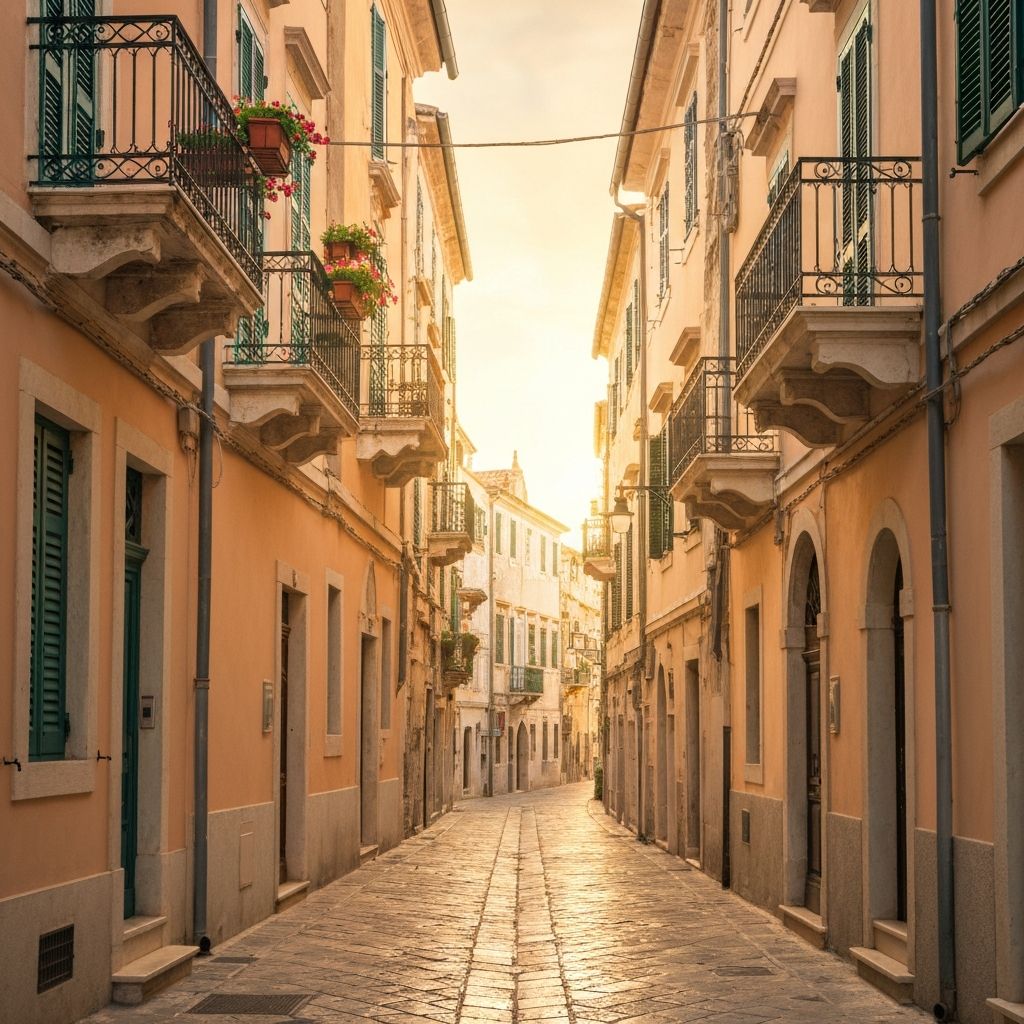
The kantounia wind between buildings that have stood for centuries, their plaster faded to shades of ochre and terracotta that no paint manufacturer could replicate. Above, iron balconies overflow with geraniums and bougainvillea. Ahead, the passage opens onto a square where a Byzantine church faces a Venetian loggia across worn flagstones. This is Corfu Town—a living palimpsest of Mediterranean culture.
Layers of History
Unlike most Greek towns, Corfu never fell to the Ottomans. This accident of history—the Venetian fortifications proved too strong, the strategic importance too great—gave the island a unique cultural trajectory. For four centuries under Venice, two decades under France, and fifty years under Britain, Corfu absorbed influences unknown elsewhere in Greece.
Walk the old town today and you read this history in architecture. The Liston arcade echoes the Rue de Rivoli in Paris, built during the brief French occupation. The Palace of St. Michael and St. George, now housing the Museum of Asian Art, is pure British neoclassicism. And everywhere, the elegant windows and graceful proportions of Venetian domestic architecture.
But beneath these layers, older foundations persist. Byzantine churches with darkened icons occupy corners beside Renaissance palazzos. Greek Orthodox bells ring alongside the hours from a Venetian campanile. The effect is not confusion but synthesis—a unique culture that could only have emerged here, in this specific place, through this specific history.
The Evening Volta
To understand Corfu Town, one must experience the volta—the evening promenade that transforms the Liston and the Spianada into an outdoor salon. This is when the town comes alive, when Corfiots of all generations dress in their finest and stroll beneath the arcades, pausing to greet friends, to be seen, to participate in a ritual as old as the town itself.
Join them. Order a ginger beer—the curious British legacy that remains Corfu's signature drink—and watch the theater of Mediterranean sociability unfold. Children chase through the crowds; couples claim benches overlooking the cricket pitch (another British import); elderly men argue politics at cafe tables they've occupied for decades.
As darkness falls and the fortress is illuminated, the scene takes on a magical quality. This is when you understand that Corfu Town is not a museum but a living place, where history is not preserved behind glass but inhabited, argued over, and continuously renewed by each generation that calls it home.
To walk these streets is to move through time, each turn revealing another century's vision of beauty.
— Lawrence Durrell